Every quality improvement (QI) project is an opportunity to reduce healthcare's environmental impact while improving health and social outcomes cost-effectively. By considering the environment throughout the whole project lifecycle, you can find simple ways to reduce your environmental footprint and avoid unintended consequences.
Before you start: Environmental impacts should always be assessed and balanced with safe care, high-quality care. If you are new to safety and QI, start with the Safety and Quality Essentials Pathway.
Considerations at each project stage
The Model for Improvement is a powerful framework that complements any change model your organisation uses. It includes three fundamental questions and a Plan-Do-Study-Act (PDSA) cycle to test change ideas:
- What are we trying to accomplish?
- How will we know that a change is an improvement?
- What changes can we test that will result in an improvement?
Plan
When planning a small test of change, ask:
- What do you expect to find?
- When will you do it?
- Who will do it?
- Where will it be done?
Do
Carry out your plan:
- Start small (one patient, one clinician, one day)
- Document problems and unexpected observations
Study
Review your data:
- Complete your analysis
- Compare results to what you expected
- Summarise what you learned
Act
Decide on next steps:
- What changes does the team need to make next?
- When will you carry out your next PDSA cycle?
You may consider environmental impacts when working through the model for improvement and at the stages listed below:
- Setting your aim statement: Design your aim to support environmental outcomes alongside social and financial benefits. Consider environmental impacts in your primary aim or as a secondary aim.
- Reviewing your process map: Identify where resources and costs are required and what the environmental impacts looks like.
- Designing change ideas: Design solutions with minimal negative environmental impact, while meeting compliance, guideline and legislation requirements.
- Measuring impact: Capture the scope of your gains and identify any unintended consequences on the environment.
- Documenting and sharing your project: Record the environmental impacts of your project so others can learn from your approach and build on it.
- Approvals and consultation: Engage early with safety and quality experts to confirm your approach meets policy, guidelines and standards.
Always balance environmental impacts against the need to deliver safe, high-quality care. If you are new to safety improvement, consider the Safety and Quality Essentials Pathway for ongoing training and development needs.
Case study: From words to images —implementing video interpreting
The Northern Sydney Local Health District From words to images — implementing video interpreting project helped health services deliver safe, effective video interpreting for culturally and linguistically diverse patients and carers, so they could take an active part in their care. Environmental impacts can be considered at these stages:
- Setting the aim statement: Video interpreting is an evidence-based way to reduce greenhouse gas emissions from travel while maintaining care quality and improving access to interpreters. The local health district covers 900 square kilometres, so interpreters can travel long distances. This makes it potentially a high-impact project.
- Reviewing the process map: Identify travel requirements, including average distances and mode of travel (such as by car), and flag these as a key environmental impact.
- Designing change ideas: Design ideas with minimal negative environmental or safety impacts and a strong positive environmental impact. For example, maximise access for patients and interpreters who could use the service, and check for any environmental impacts of the new process.
- Measuring impact: Measures include the number of video sessions and cost savings over one financial year. Calculate financial savings by comparing the total cost of delivering the same sessions in person. You can also estimate the kilometres of car travel saved.
- Documenting and sharing the project: Include these measures and acknowledge the environmental impact as a key benefit in project reports.
Principles of sustainable care
The principles of sustainable healthcare guide how to reduce the resources required for care, while improving quality, maintaining safety and managing cost. One or more may apply to your project:
Keep communities healthy
An environmentally sustainable healthcare system helps people stay healthy, well and independent, which reduces the need for healthcare. Prevention and health promotion activities, such as tobacco control and healthy eating initiatives, support this goal and deliver significant community and financial benefits.
Reduce low-value and unnecessary care
Unnecessary and potentially harmful care is estimated to contribute around 30% of the carbon footprint of clinical services. Overdiagnosis, misdiagnosis and overtreatment carry environmental, health and financial costs. Spinal x-rays, for example, are often ordered when they offer little clinical benefit, and unnecessary blood tests are another common source of low-value care.
See NSW Health value-based healthcare for identifying and addressing low-value care.
Reduce emissions and waste in high value care
Every resource used in care contributes to greenhouse gas emissions. Using resources efficiently minimises environmental impact while supporting value and cost efficiency.
Resources include:
- medical supplies (medications, anaesthetic gases, medical and surgical equipment)
- non-medical supplies (office furniture, IT equipment, stationery)
- travel (staff and patient travel)
- energy (lighting, computers, medical equipment, air conditioning, phones)
- water (for services such as linen).
Apply these alongside patient safety and policy requirements to keep care high-value and prevent harm.
Practical approaches by resource type
Consider how your QI project affects medical and non-medical supplies, travel, energy and water.
Reducing the amount of medical or non-medical supplies needed to provide a service can reduce the energy, water and emissions needed to make and transport items and reduces packaging waste. Look for lower-impact alternatives, such as smaller-footprint packaging or moving to intravenous administration of medication only when clinically necessary.
Staff, patient and carer travel generates emissions, varying by mode. Reducing travel benefits people in rural and remote areas where distances are long, and people with accessibility limitations.
Examples include virtual care options and aligning appointments to reduce trips. The Virtually Equipped Therapy Options project explored using iPads to support virtual care delivery.
Healthcare depends on energy across every service. Reduce demand by turning equipment off when not in use or transition to more efficient alternatives.
The CT Switch for Savings initiative reduced emissions by switching CT scanners off between scans. LED lighting upgrades have delivered similar gains
Water is used across clinical and non-clinical services, including dialysis and linen. Where safe and appropriate, services can repurpose water or improve efficiency. Some sites are exploring how to reuse water from dialysis treatments, with clinical impacts considered first. Non-clinical reuse is generally preferred where it is safe and feasible.
The 3 Rs for sustainability
Three approaches help reduce the emissions associated with healthcare:
Reduce
Use less or eliminate an item without compromising care safety or quality.
Example: the Gloves Off! initiative supports staff to assess the risk of glove use, reducing single-use disposable glove use.
Reuse
Safely reuse or repurpose equipment, or transition from disposable to reusable items.
Examples:
- the Pressure to Reduce Waste project aimed to repurpose positive airway pressure (PAP) devices
- the Reusable Sterile Operating Theatre Lights project transitioned to sterile light coverings and removed the need for single-use coverings
- reusable sterilised holloware reduced single-use plastic in operating theatres.
Recycle
If an item cannot be reduced or reused, recycling lowers its environmental impact compared with other forms of disposal.
Example: Hunter New England LHD’s Outfits to Fitouts project has diverted more than seven tonnes of old uniforms from landfill. The staff-led initiative turns uniforms into eco-friendly ceramic tiles using UNSW technology, then uses them in district infrastructure projects.
Any reduce, reuse or recycle change must meet existing policy, guideline, standard and procurement requirements. Balance environmental gains with the need to deliver safe, quality care.
Circular economy in healthcare
Circular economy is a practical way to reduce waste, pollution and emissions in healthcare. It keeps products, equipment and infrastructure in use for as long as possible by reusing, sharing, repairing, refurbishing, remanufacturing and recycling materials.
Where circular economy applies
Circular economy principles apply directly to non-clinical activities in healthcare such as office equipment, uniforms and packaging.
For clinical and patient care, circular economy principles apply within the limits of regulations, policies and guidelines. Safe care must always come first. The health circular hierarchy below sets out how to balance these priorities.
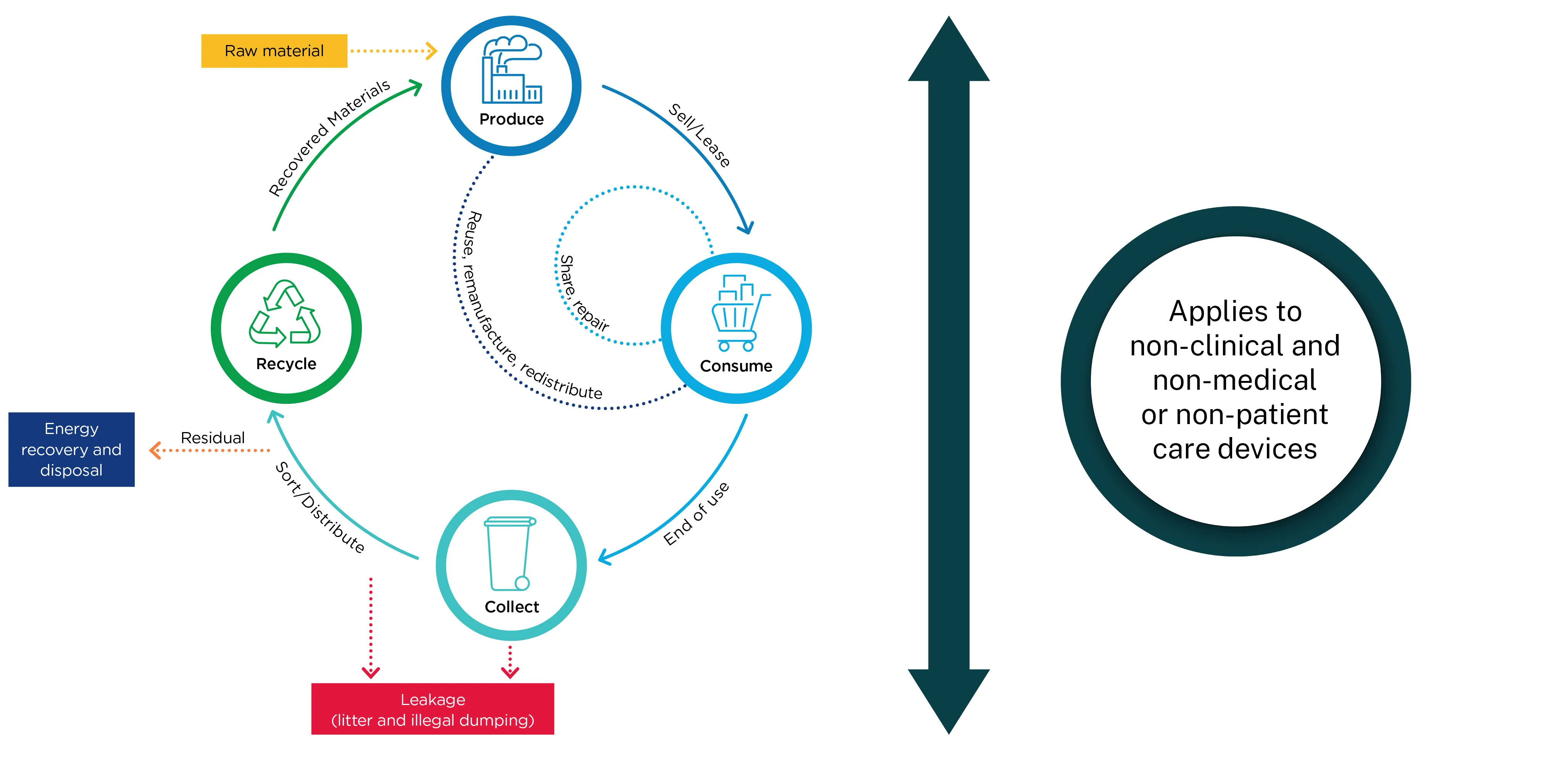
The health circular hierarchy
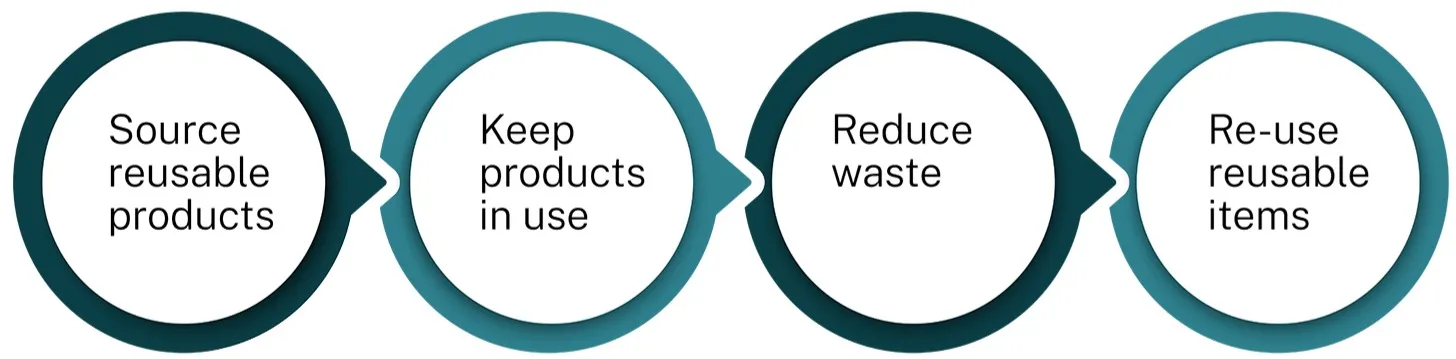
When making procurement and decide decisions for clinical care, follow this hierarchy from highest to lowest priority:
- Source reusable medical devices and equipment that can be cleaned, disinfected, sterilised or reprocessed.
- Reduce procurement of single-use devices and equipment.
- Consider personal protective equipment (PPE) risk assessment and Gloves Off! campaigns.
- Repurpose non-medical devices for alternate use.
- Recycle clean plastics.
- Design devices for remanufacturing.
Example: Infection prevention and control and sustainability
Infection prevention and control (IPC) and sustainability teams can work together to support shared goals. They can promote horizontal IPC practices, such as high hand hygiene compliance. These practices reduce infection risk without generating waste. This approach supports both patient safety and environmental sustainability.
Find out more about circular economy in healthcare with practical examples from Hunter New England LHD.
Resources
- Explore examples of environmental sustainability QI projects in NSW Health through the Agency for Clinical Innovation's Innovation Exchange.
- View case study examples from Hunter New England Local Health District.
- Find examples in the UK's National Health Service through the Sustainability in Quality Improvement website.
References
- Australian Commission on Safety and Quality in Healthcare, 2024. Joint Statement on Climate Change in Health. Department of Health and Aged Care. Accessed 20 November 2024.
- Australian Commission on Safety and Quality in Health Care. Environmental Sustainability and Climate Resilience Healthcare Module.
- Baid, H., Damm, E., Trent, L. & McGain, F., 2023. Towards net zero: critical care. BMJ, 381: e069044.
- Barratt, A., Bell, K., Charlesworth, K. & McGain, F., 2021. High Value health care is low carbon health care. The Medical Journal of Australia, 26 October, Vol. 216, Issue 2.
- Barratt, A., Bell, K., Charlesworth, K. & McGain, F., 2022. High value health care is low carbon health care. The Medical Journal of Australia.
- Department of Planning, Industry and Environment (DPIE), 2021. NSW Waste and Sustainable Materials Strategy 2041. NSW DPIE. Accessed 20 November 2024.
- Hoffmann, T., Glasziou, P., & Del Mar, C. (2023). Overdiagnosis and too much medicine in a world of crises. BMJ, 382, p1865. doi: https://doi.org/10.1136/bmj.p1865.
- Keil, M., Frehse, L., Hagemeister, M., Knieß, M., Lange, O., Kronenberg, T., Rogowski, W. (2025). Carbon footprint of healthcare systems: a systematic review of evidence and methods. Journal Name, [online] Available at: https://doi.org/10.1136/bmjopen-2023-078464 [Accessed 14 February 2025].
- NSW Environmental Protection Authority (EPA), 2022. The Waste Hierarchy. NSW EPA. Accessed 20 November 2024.
NSW Health. Environmental Impact of Desflurane. Available at: www.health.nsw.gov.au/netzero/Factsheets/environmental-impact-desflurane.pdf. - NSW Health, 2024. Net Zero. Available at: https://www.health.nsw.gov.au/netzero/Pages/default.aspx.
- Spoyalo, K., Lalande, A., Rizan, C., Park, S., Simons, J., Dawe, P. (2025). Patient, hospital and environmental costs of unnecessary bloodwork: capturing the triple bottom line of inappropriate care in general surgery patients. Journal Name, [online] Available at: https://bmjopenquality.bmj.com/content/12/3/e002316 [Accessed 14 February 2025].
- Thomas, L., Molineux, A. (2025). What is Overdiagnosis and Why is it Bad? News-Medical.net. Available at: https://www.news-medical.net/health/What-is-Overdiagnosis-and-Why-is-it-Bad.aspx [Accessed 14 February 2025].
- WHO, 2023. Operational framework for building climate resilient and low carbon health systems. Report, 9 November.