Human factors is the study of how people interact with the systems they work in, and how to design those systems so that safe care is easier to deliver. It is not about fixing people. It is about designing systems that help people work safely and effectively.
Human factors is embedded in NSW Health’s approach to incident reviews, improvement work, education design, and policy, procedure and system review. We work with local health districts and specialty health networks to put this in practice. Alongside clinical teams, we build this thinking into how care is planned, delivered and reviewed. Use the principles, model and programs below to apply it in your work.
Healthcare is a complex, adaptive system. Safety outcomes rarely come from a single decision, action or person. They emerge from how people, tasks, tools, environments and organisations interact over time.
Care happens under real-world pressure: competing demands, interruptions, variability between patients and teams, and imperfect tools. Most of the time, care is delivered safely because people adapt their work to meet these conditions. A human factors approach helps us understand how work is actually done, and how system design shapes performance.
Three principles guide the approach
- Use a systems approach - Treat safety and quality as outcomes of the whole system, not of individuals. Look at how conditions shape decisions, treat variability and adaptation as normal, and focus on interactions rather than isolated parts.
- Design-driven improvement - Strengthen system design rather than rely on individual vigilance or compliance. Shape tasks, tools and processes to fit real clinical work, and cut unnecessary complexity and cognitive load.
- Focus on system performance and human wellbeing - Safe, reliable care and staff wellbeing depend on each other. Systems that perform well support people, and people who are supported deliver safer, higher quality care.
These principles are inseparable. Systems that perform well support people in them. People who are supported are better able to deliver safe, high‑quality care.
The SEIPS model
Use the Systems Engineering Initiative for Patient Safety (SEIPS) model to put these principles into practice. It gives you a simple, practical way to see how outcomes emerge from a system, by looking at three connected parts:
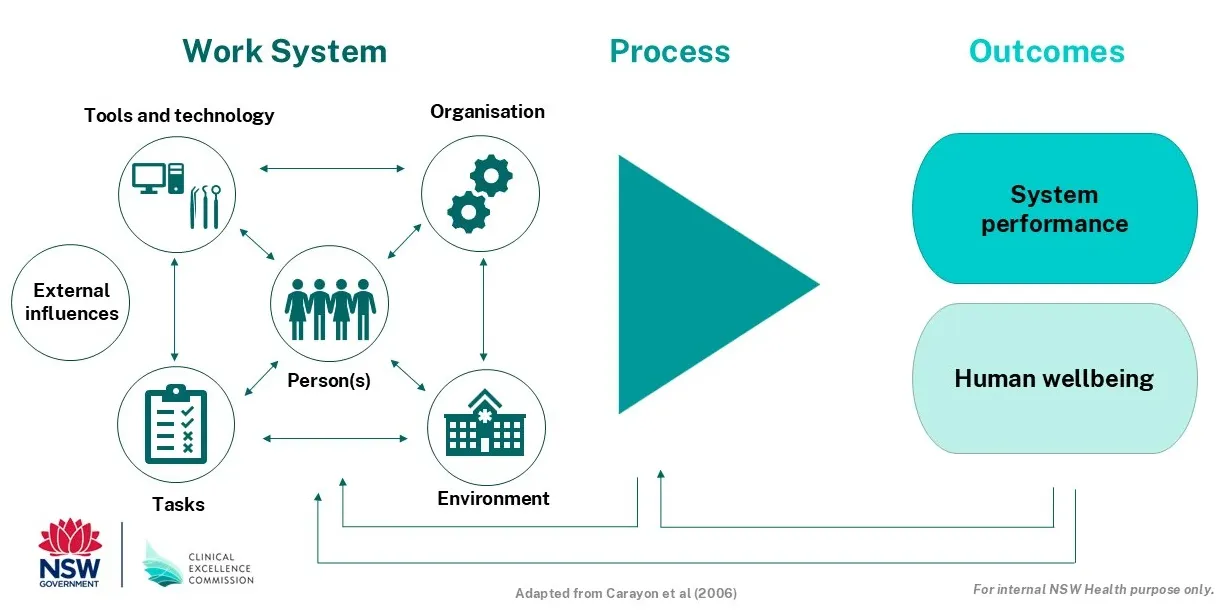
- The work system shapes how care is delivered:
- people: skills, experience, capacity, fatigue
- tasks: complexity, sequencing, time pressure
- tools and technologies: usability, reliability, information flow
- physical environment: layout, noise, workspace design
- organisation: policies, resources, leadership, culture.
- The processes of care are how work is done in practice or work as done.
- The outcomes are system performance and human wellbeing for staff, patients, carers and families.
SEIPS gives you a shared language across incident reviews, education, improvement work and system design. It supports consistent thinking about safety at the clinical, operational and organisational level.
Build your capability
Human factors is built into our education programs available through My Health Learning. These programs help you understand healthcare as a complex system, recognise how system conditions influence decisions and performance, and reflect on work as done in real clinical settings.
- Applied Safety and Quality Program
- Between the Flags
- Perinatal Safety Education
We also run a SEIPS masterclass to grow this capability across NSW. You can also connect with others through our human factors community of practice. To take part in either, contact our Patient Safety team.
Apply it in improvement work
Human factors keeps improvement work focused on system design rather than individual performance. It is one of the Tenets of Safety and Quality in the Applied Safety and Quality Program, with two sessions dedicated to it (modules 1 and 3).
Applying human factors to improvement work supports changes that are more likely to be effective and sustainable in real clinical settings.
More about the Applied Safety and Quality Program
Apply it to system and policy design
You can also apply human factors to the design and review of policies, procedures and systems, ensuring they match how work is actually done.
This means considering:
- usability and cognitive workload
- how guidance supports safe decision‑making and adaptation
- how new systems or changes may be experienced in practice.
Use human factors for a consistent way to design, review and improve healthcare systems. This supports safer care for patients and staff.