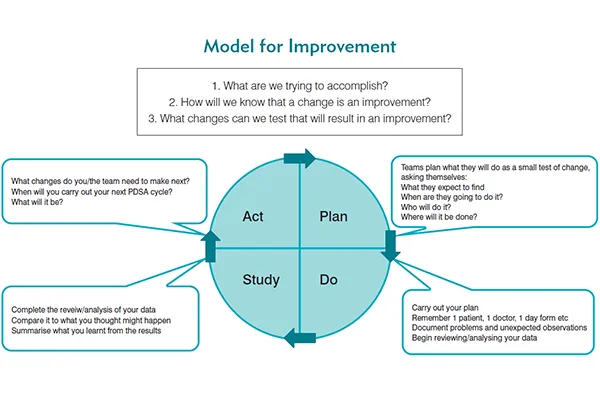
Use the Model for Improvement and Plan-Do-Study-Act (PDSA) cycles together to plan, test and evaluate quality improvement projects. The Model for Improvement structures your project around three core questions. PDSA cycles let you test changes on a small scale before scaling up.
The Model for Improvement was developed by Associates in Process Improvement and is used by improvement teams worldwide, including the Institute for Healthcare Improvement (IHI).
The model is built around three questions. You can answer them in any order, but most teams start with the aim.
- What are we trying to accomplish? This is your aim. Set a clear, measurable goal for your project.
- How will we know that a change is an improvement? This is your measurement plan. Decide what data you will collect and how you will know the change has worked.
- What changes can we make that will result in improvement? These are your change ideas: the specific actions you will test.
PDSA cycles
Once you have identified a change to test, use a PDSA cycle to test it on a small scale before scaling up. Each cycle has four steps:
Plan
When planning a small test of change, ask:
- What do you expect to find?
- When will you do it?
- Who will do it?
- Where will it be done?
Do
Carry out your plan:
- Start small (one patient, one clinician, one day)
- Document problems and unexpected observations
Study
Review your data:
- Complete your analysis
- Compare results to what you expected
- Summarise what you learned
Act
Decide on next steps:
- What changes does the team need to make next?
- When will you carry out your next PDSA cycle?
Environmental impact
Use the three questions of the Model for Improvement to think about environmental impact at every stage of your project:
- include environmental outcomes in your aim where relevant
- measure environmental impact alongside other outcomes
- consider environmental factors when generating and prioritising change ideas.
More about sustainability in quality improvement