Medication reconciliation (Med Rec) is a formal process for confirming a patient's current medicines at every transfer of care. It helps prevent unintentional changes, such as overlooked, duplicated or incorrectly recorded medicines, when patients are admitted, transferred or discharged.
Why Med Rec matters
Around half of all hospital medication errors occur at admission or discharge. About 30% of these have the potential to cause harm. Unintentional changes to a patient's medicines at transfers of care are linked to poorer health outcomes, increased readmissions and higher mortality.
A formalised Med Rec process can prevent these errors and adverse drug events.
The Med Rec framework (PDF 181.9 KB) explains how formalised Med Rec processes benefit patients and what actions are required to achieve those benefits.
The four steps of Med Rec
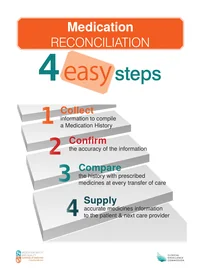
Med Rec follows four steps:
- Collect information to compile a list of the patient's current medicines, with clear name, dose and frequency for each.
- Confirm the accuracy of that list to achieve a best possible medication history (BPMH).
- Compare the BPMH against prescribed medicines at every transfer of care, identifying and resolving any discrepancies.
- Supply accurate medicines information to the patient and the next care provider.
Steps 1 and 2 build the BPMH, which is the foundation of every medication treatment decision.
Best possible medication history
A BPMH is an accurate and complete list of every medicine a patient is currently taking. It includes prescription, over-the-counter and complementary medicines, along with allergies and adverse drug reactions.
The BPMH supports continuity of care, reduces medication errors and informs every medicine treatment decision.
Under the Medication Safety Standard, NSW Health services must document a BPMH on presentation (or as early as possible in the episode of care) and reconcile any discrepancies between the BPMH and current medication orders at every transition of care.
Resources
- Obtaining a BPMH presentation (PDF 213.5 KB)
- BPMH interview guide for clinicians (PDF 139.0 KB)
- Taking a BPMH training video
- Taking a BPMH learning module
Improving your local Med Rec process
A clearly defined process makes it more likely that Med Rec will be completed for every patient. The Med Rec toolkit sets out a step-by-step guide and worked examples you can adopt locally. For the quality improvement (QI) approach underpinning this toolkit, see the improvement science guide.
Med Rec relies on multidisciplinary teamwork and effective communication. Consider who is responsible for, where in the patient journey, and how your team will:
- document medication histories, changes, interventions and plans so they are accessible to all clinicians
- communicate and resolve medication discrepancies, interventions and changes
- generate and supply medicines information, including patient-friendly information (PDF 654.5 KB), at the point of transfer or discharge
- measure and report on Med Rec data.
Register your interest to join the Med Rec Quality Improvement Community of Practice and share learnings with colleagues working to improve Med Rec across NSW.
Education
Explore our learning programs on My Health Learning by searching the course codes below:
- Continuity of medication management learning module: course code 157075702
- Nursing and midwifery Med Rec workshops:
- The Case for Med Rec: course code 197557236
- Med Rec on admission: course code 197563085
- Med Rec beyond admission: course code 197563158
Resources
- Medication reconciliation presentation (PDF 1.6 MB)
- Beyond admission presentation (PDF 1.7 MB)
- Med Rec frequently asked questions (PDF 113.6 KB)
Posters


References
- Gillespie, U., A. Alassaad, et al. (2009). A comprehensive pharmacist intervention to reduce morbidity in patients 80 years or older: A randomized controlled trial. Archives of Internal Medicine 169(9): 894-900.
- Cornish PL, Knowles SR et. al. (2005). Unintentional medication discrepancies at the time of hospital admission. Arch Intern Med 165: 424-429.
- Australian Commission on Safety and Quality in Health Care. (2017). National Safety and Quality Health Service Standards Guide for Hospitals. Sydney: ACSQHC.